
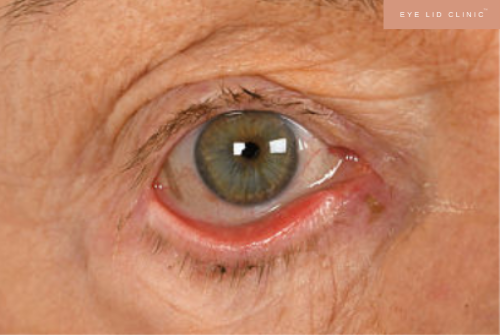
Ectropion
- Definition:
- Eyelid sags and turns outward, causing irritation, infections, and potentially corneal ulcers.
Types
- Involutional: Age-related changes, common after 60.
- Cicatricial: Caused by skin scarring (burns, trauma, skin conditions).
- Paralytic:Due to facial paralysis (e.g., Bell’s palsy).
- Mechanical:Caused by a mass pulling the eyelid outward.
- Congenital:Present since birth, rare.
- Post-blepharoplasty:Complex, varies by cause.
Symptoms
- Watery eyes
- Ocular irritation
- Mucoid discharge
- Redness
- Sensitivity to light and wind
Signs
-
Redness, vision changes, copious discharge, pain, white corneal spots.
Diagnosis
-
Eye exam by optician or GP, possibly referred to an ophthalmologist.
Conservative Management
-
Artificial tears, emollient creams, eyelid massage.
Surgery
-
Corrects position, involves techniques based on ectropion type, may
involve skin grafts or flaps. Lateral tarsal strip, lateral canthoplasty, inferior retractor
plication- reattachment
Aftercare
-
Antibiotic ointment, cold compresses, monitoring for complications.
Faq
Types & Causes of Ectropion
1. Involutional (Age-related)
- Most common type.
- Caused by gradual laxity of eyelid muscles, tendons, and supporting tissues.
- Typically appears in later adulthood.
2. Cicatricial (Scarring-related)
- Due to skin contraction from trauma, burns, previous surgery, inflammatory skin disease, or dermatological scarring.
- Scar tissue pulls the eyelid outward.
3. Paralytic
- Results from facial nerve weakness (e.g., Bell’s palsy, facial nerve palsy).
- Loss of muscle tone prevents normal eyelid position and closure.
4. Mechanical
- A mass or lesion on the lower eyelid can weigh the lid down, pulling it outward.
5. Congenital
- Present from birth.
- Extremely rare and typically due to structural abnormalities.
Ectropion leads to ocular surface exposure and poor tear distribution. Common symptoms include:
- Excessive tearing (epiphora)
- Irritation and redness
- Sensitivity to light and wind
- Dryness or gritty sensation
- Mucoid discharge
Urgent care is required if redness becomes severe, pain increases, vision changes occur, or a white spot on the cornea is seen—these may indicate corneal ulceration or infection.
Diagnosis
Ectropion is typically identified during an eye examination by an optometrist or general practitioner and confirmed by an oculoplastic surgeon. Assessment includes:
- Eyelid position and tone
- Degree of laxity
- Presence of scarring, previous surgery, or lesions
- Corneal health and tear function
Complications may include:
- Persistent irritation and redness
- Overflow tearing
- Recurrent conjunctivitis
- Corneal dryness, abrasions, or ulcers
- Sensitivity to light
- Visual risk if corneal damage becomes severe
These measures do not correct ectropion but reduce discomfort:
- Lubricating eye drops/ointments
- Emollient creams for dry periocular skin
- Gentle upward lid massage
- Sunglasses to protect from wind/light
- Cold compresses to ease irritation
Purpose
Corrects eyelid malposition by tightening, repositioning, or reconstructing the eyelid so it rests properly against the eye.
Anaesthesia
Usually performed under local anaesthetic, sometimes with mild sedation.
Surgical Approach
Depends on the type of ectropion:
Involutional Ectropion
- Lower eyelid tightening, often via a lateral canthal tightening procedure.
- Repositions the eyelid to restore normal tension.
- May require skin grafting or a skin flap in addition to tightening.
- Skin graft donor areas may include upper eyelid, post-auricular region (skin from behind ear), or upper arm.
Mechanical Ectropion
- Requires management of the causative lesion (e.g., excision, biopsy).
- Lid position is corrected once the weight effect is removed.
Paralytic Ectropion
- Multi-modality approach to protect the cornea.
- May involve tightening procedures plus supportive measures.
Incisions & Sutures
Incisions are typically placed in natural eyelid creases to minimise visible scarring. Sutures are usually removed within 1–2 weeks.
Postoperative Recovery
Common postoperative features:
- Temporary swelling and bruising
- Mild discomfort
- Use of antibiotic and steroid ointments
- Lubricating drops after surgery
Activity restrictions for ~1 week:
- Avoid heavy lifting, strenuous exercise, and bending forward.
- Keep the area clean; avoid rubbing the eyelid.
Cold compresses may reduce swelling. Most patients notice immediate correction of eyelid position.
Typically 30–90 minutes, depending on the type and complexity of the ectropion.
Possible risks include:
- Infection
- Bleeding or bruising
- Scarring
- Under- or over-correction
- Persistent tearing or dryness
These complications are uncommon and often manageable.